


Autodesk, together with 9 international organizations, has developed the Large Additive Subtractive Integrated Modular Machine (LASIMM), an installation for hybrid production that can produce metal elements and construction structures up to 6 meters high, 2 meters in diameter and weigh up to 2000 kg with 3D printing. . Together with Autodesk, five companies, two universities and two research institutes from Belgium, the United Kingdom, Denmark, Spain, Germany and Portugal worked on the project. The installation itself is located on the Loxin industrial site in Pamplona, Spain.
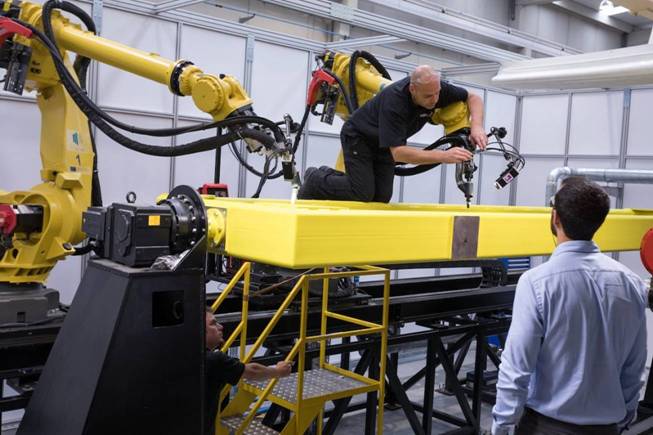
The project partner, Global Robots, is developing one of the LASIMM robotic manipulators, which is part of a massive 14x11x5 m size image. The image is provided by Loxin.
In the framework of the test system, there will be a demonstration of samples – large cantilever beam constructions, aircraft panels and parts of wind turbines. They were designed to maximize the capabilities of LASIMM in additive manufacturing, machining, cold processing, measurement and control. These technologies offer the optimal solution for hybrid production of large structural elements and provide a predicted reduction of costs and time by 20%, as well as an approximate increase of productivity by 15% with large-scale additive production. Among other expected benefits of LASIMM is the reduction of the working space, the localization of production conditions, the reduction of supply chains, etc.
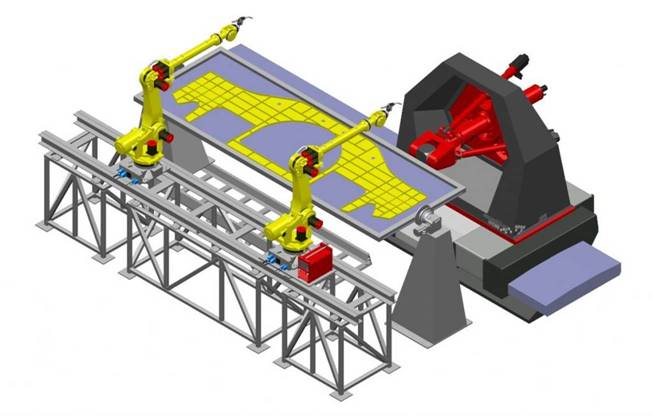
View LASIMM in Autodesk PowerShape software. Image provided by Loxin.
LASIMM has a modular structure, consisting of industrial robotic hands for the implementation of additive aluminum and steel production, as well as a specialized milling robot to remove excess material. This will allow the whole industry to move from the creation of standardized components to individual solutions. Among these industries are aerospace, renewable energy, transport, construction and many others. As a leading developer of software within the Autodesk project, it extends the boundaries of product manufacturing, moving from the principle of CAM system “one equipment – one process” to the system “hybrid equipment – several processes” and management of such installations, which combine several technologies for the production of the final component. This approach plays a key role in the preparation of hybrid production and the need to create control programs for such machines.